
A mini-ITX gaming PC build costs about $1,945 in September 2026, and roughly $175 of that is the price of going small. The rest is the same memory crisis hitting every build this year: the cheapest 32GB DDR5-6000 CL30 kit tracked on 7 September was $489.99 (TechFuel HQ, 2026).
This guide prices every part from pages checked on 10 September 2026, explains why each one made the list, and separates the small-form-factor premium from general inflation. Small builds also carry constraints a mid-tower forgives, such as two RAM slots, a 67mm cooler limit and only two M.2 slots. Those change what you should buy on day one.
One limit up front: we haven't built or benchmarked this exact machine. It's a parts list assembled from manufacturer spec sheets, published reviews and live prices, with the reasoning shown so you can swap parts without breaking the fit.
Note
Key Takeaways
- The eight-part build below totals about $1,945 at prices checked on 10 September 2026.
- The small-case premium comes to roughly $175: about $100 on the SFX power supply, $46 on the board and $30 on the case.
- Mini-ITX boards have two RAM slots, so buy 32GB once. Adding a second kit later isn't possible.
- The Cooler Master NR200P V2 fits air coolers up to 67mm tall, which rules out every tower cooler.
- The RX 9060 XT 16GB at $470 is the GPU pick; the RTX 5060 Ti 16GB sits at $780.
What Does a Mini-ITX Gaming PC Cost in 2026?
At prices checked on 10 September 2026, a sensible 1440p-capable mini-ITX build costs about $1,945. Memory and the GPU account for almost half of that. Of the total, roughly $175 comes from choosing small-form-factor parts over their ATX equivalents.
The Parts List
| # | Component | Pick | Price checked 10 Sep 2026 |
|---|---|---|---|
| 1 | CPU | AMD Ryzen 5 9600X | $175.95 |
| 2 | Cooler | Thermalright AXP120-X67 | $44.00 |
| 3 | Motherboard | ASRock B850I Lightning WiFi | ~$210 (see note) |
| 4 | Memory | 32GB (2x16GB) DDR5-6000 CL30 | $489.99 |
| 5 | GPU | PowerColor Reaper RX 9060 XT 16GB | $470.00 |
| 6 | Storage | ADATA Legend 710 2TB NVMe | $219.99 |
| 7 | PSU | Corsair SF750 (SFX) | $199.99 |
| 8 | Case | Cooler Master NR200P V2 | $134.99 |
| Total | ~$1,945 |
A note on the board: reviews listed it at $209.99 (Tech4Gamers) and $220 (NoobFeed). The major retailers blocked automated price checks on 10 September, so treat $210 as an estimate and check the live price before you order. Every other figure comes from a retailer, the manufacturer, or a price tracker updated that week.
Why Is a Mini-ITX Build More Expensive Than ATX?
Three parts carry the mini-ITX premium, the SFX power supply, the small board and the case, and together they add about $175 over ATX equivalents. That's around 9% of this build, priced on the same day.
| # | Part | Mini-ITX pick | ATX equivalent | Premium |
|---|---|---|---|---|
| 1 | PSU | Corsair SF750, $199.99 | Corsair RM750e, $99.99 | ~$100 |
| 2 | Board | ASRock B850I, ~$210 | ATX B850, ~$164 implied | ~$46 |
| 3 | Case | NR200P V2, $134.99 | Corsair 4000D Airflow, $104.99 | ~$30 |
The power supply is the biggest line. Corsair's store listed the SF750 at $199.99 and the ATX RM750e at $99.99 on the same day (Corsair, 2026). The comparison isn't perfectly like-for-like: the SF750 is 80 Plus Platinum and the RM750e is Gold, and the RM750e showed as out of stock. A Gold-rated SFX unit would narrow the gap. We couldn't confirm a live price for one on 10 September, so read $100 as the top of the range.
The ATX board figure is implied rather than quoted. A Micro Center bundle paired the Ryzen 5 9600X with a Gigabyte B850 Gaming WiFi for $339.99 (PC Guide, 2026). Subtracting the CPU's $175.95 street price leaves about $164 for the board.
The Tax You Pay Later
The bigger cost of mini-ITX doesn't appear on the receipt. The ASRock B850I Lightning has two DIMM slots and two M.2 slots (Tech4Gamers). On an ATX board, 16GB now and 16GB later is a workable plan. Here, upgrading means selling the first kit and buying a new one.
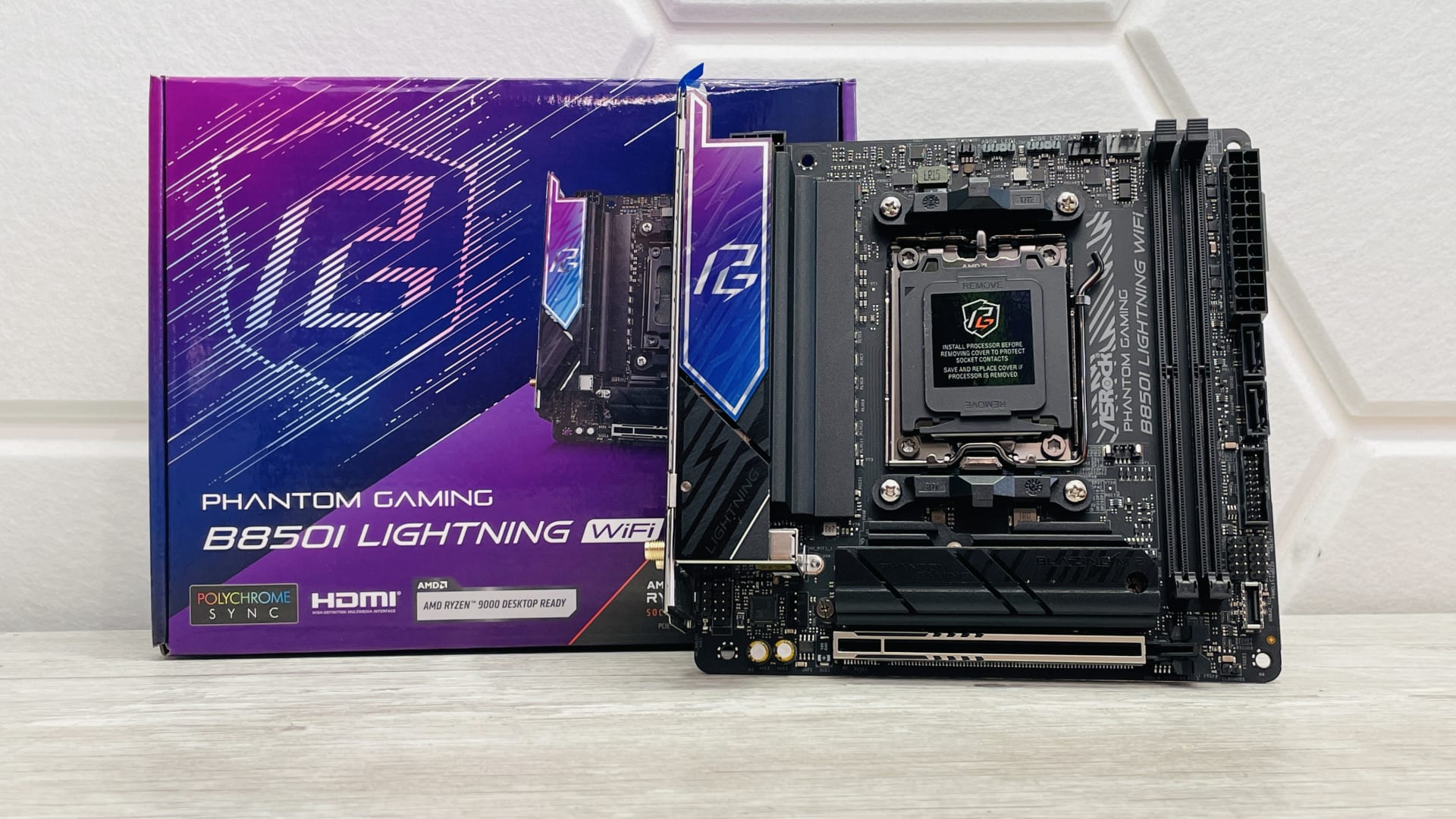
That's why this list buys 32GB and a 2TB drive up front. MemoryIndex's 10 September figures put a 16GB module at $281.77 and a 32GB kit at $455.45, or about $17.60 per gigabyte against $14.23 (MemoryIndex, 2026). Buying the smaller amount first and replacing it later is the most expensive route there is.
Which CPU Suits a Small Case?
The Ryzen 5 9600X is the right CPU here because it runs at 65W by default, which a 67mm cooler can handle quietly. Amazon listed it at $175.95 against a $279 list price (PC Guide, 2026).
It's a six-core, twelve-thread chip whose default 65W limit can be raised to 105W in the BIOS (PC Guide, 2026). In a small case, leave it at 65W. The extra 40W becomes heat in 18 litres of air. And at 1440p the graphics card sets the frame rate far more than the CPU does.
The Ryzen 7 9800X3D is the chip ITX enthusiasts usually want, and TechRadar reported it on sale for $430 (TechRadar). It's the better gaming CPU, but pair it with the 280mm AIO the NR200P V2 supports rather than a low-profile air cooler. That swap adds roughly $250 before the cooler. Our Ryzen 5 vs Ryzen 7 comparison covers when the extra cores and cache actually matter.
Why This Case and This Cooler?
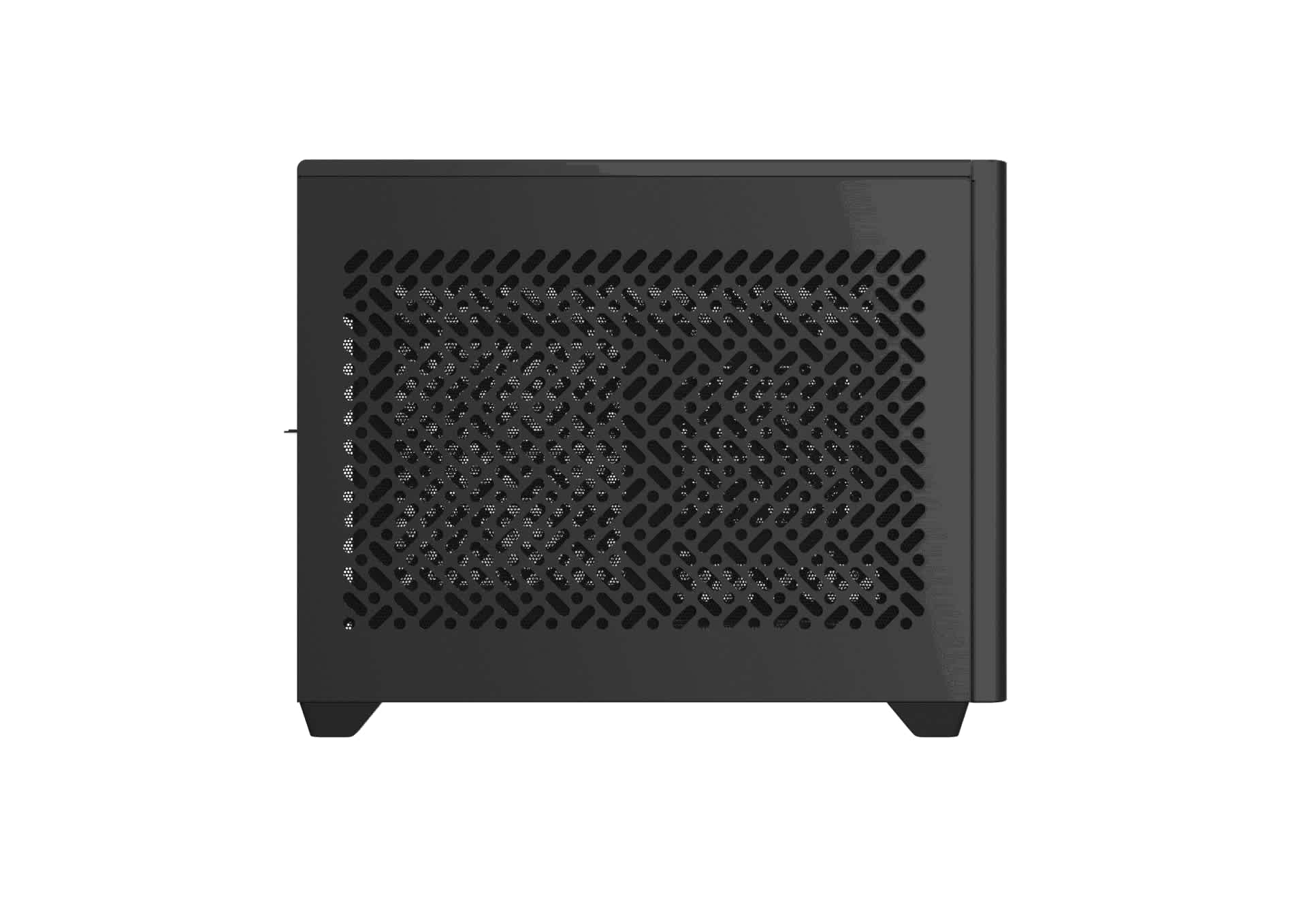
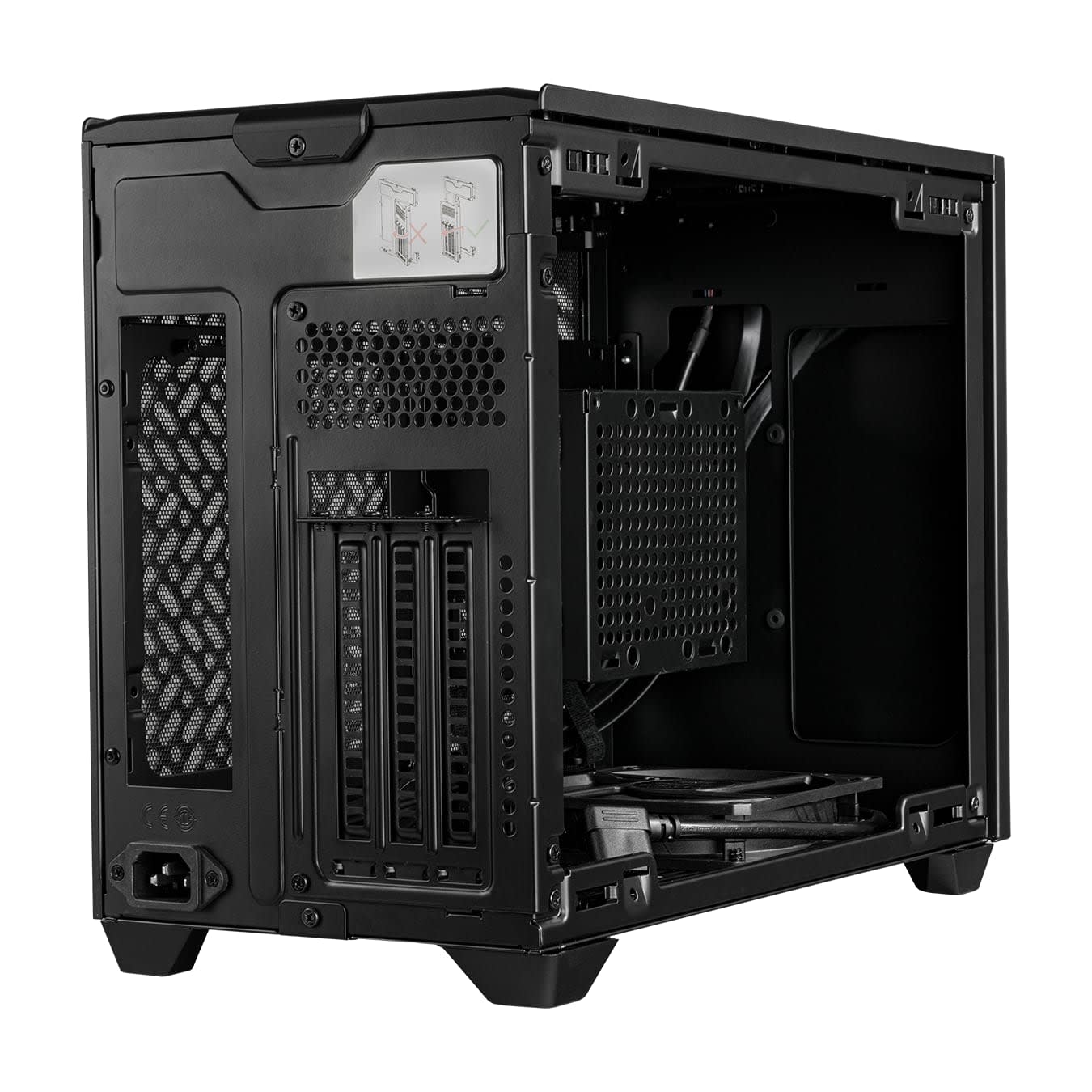
The Cooler Master NR200P V2 costs $134.99 and gives an 18.25-litre case room for full-size GPUs. The trade-off is a 67mm limit on air-cooler height (Cooler Master, 2026).
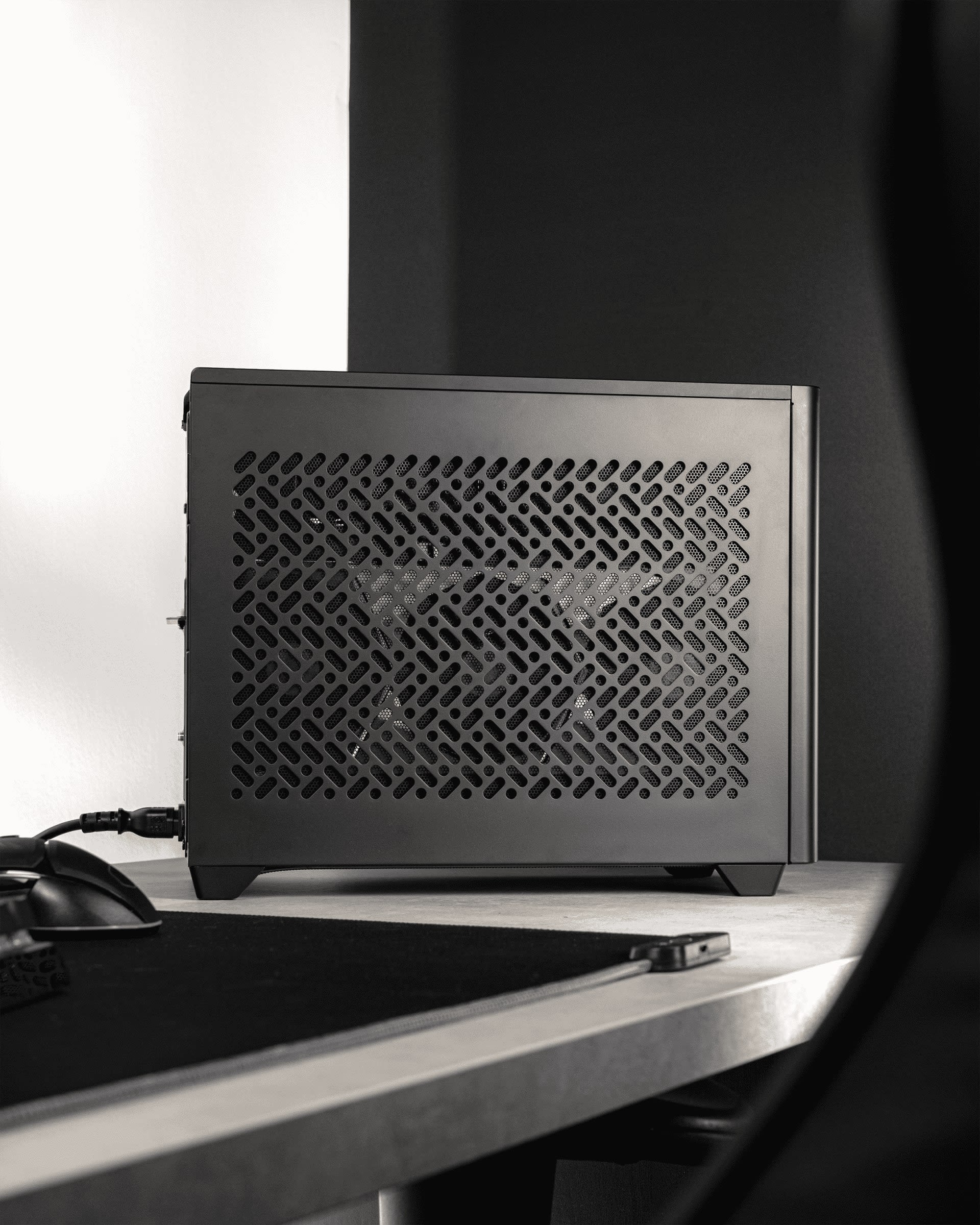
Cooler Master's spec sheet lists GPU support up to 357mm long, 160mm tall and triple-slot width, SFX or SFX-L power supplies, and a top mount for 240mm or 280mm radiators. PCWorld noted that the V2 moved to vertical-only GPU mounting and cut air-cooler clearance from the original's 76mm to 67mm, because the redesign prioritises liquid cooling (PCWorld, 2024).
Vertical mounting puts the graphics card on a riser cable. If the riser limits the link to PCIe 4.0, a card in this class gives up very little, for the reasons in our PCIe 5.0 vs PCIe 4.0 breakdown.
A 67mm Cooler for a 67mm Limit
The Thermalright AXP120-X67 is exactly 67mm tall. Zero millimetres to spare. It uses a 120mm by 15mm fan and supports AM5 (SFF.gg). Computer Orbit had it in stock at $44.
SFF.gg's review, run on a Ryzen 7 7800X3D, measured about 40dB at full fan speed from 50cm. It also warned that a top-mounted fan close to a side panel can cause turbulence. The same review lists 40mm of RAM clearance, so check your memory kit's heatsink height before you buy. Tall RGB kits are the usual casualty.
Which GPU Fits Best?
The RX 9060 XT 16GB is the best graphics card for this build, because $470 buys 16GB of VRAM and a 160W power rating that an 18-litre case can cool. Its cheapest Nvidia rival, the RTX 5060 Ti 16GB, was $780 on the same day.
GPU Prix listed a PowerColor Reaper RX 9060 XT 16GB at $470 at Newegg on 10 September. That's 35% over AMD's $349 launch price but close to its three-month typical of $449 (GPU Prix, 2026). The RTX 5060 Ti 16GB's cheapest listing that day was $780, 82% over its $429 MSRP (GPU Prix, 2026). That $310 gap decides the question.

The Reaper is a short dual-fan card, well inside the NR200P V2's 357mm limit. Heat matters more than length in 18 litres: a 160W card is far easier to keep quiet than a 300W one. Spend on VRAM before shader count. Our guide to how much VRAM you need for gaming explains why 8GB cards are a poor buy for a 1440p build in 2026.
Memory, Storage and Power
On a two-slot board, buy one 32GB kit and one 2TB drive on day one. Mini-ITX leaves no free slots for adding capacity later.
Memory: 32GB Once
TechFuel HQ's index found the cheapest qualifying 32GB DDR5-6000 CL30 kit at $489.99 on 7 September, with tracked kits running $459.99 to $649.99 (TechFuel HQ, 2026). MemoryIndex put the average retail 32GB kit at $455.45 on 10 September, up 13% in 30 days (MemoryIndex, 2026). Prices are still rising, so waiting is unlikely to save money.
If 32GB feels like more than you need, our breakdown of whether 32GB is overkill for gaming makes the case, and on a two-slot board the argument gets stronger. Owners of this board report that some DDR5 kits needed manual tuning or BIOS updates to hold their rated profile (Review-Rating). Update the BIOS first; the board's Flashback feature works without a CPU installed. If EXPO still won't stick, see our guide to DDR5 not running at its rated speed.
Storage: 2TB, Because the Slots Run Out
CheapestSSD's 10 September data had the Kingston NV3 1TB at $156.77 and the ADATA Legend 710 2TB at $219.99, or $110 per terabyte (CheapestSSD, 2026). The 2TB drive is cheaper per gigabyte, and it keeps the board's second M.2 slot free for later. That second slot is on the back of the board, so fill it before the board goes into the case.
Power: 750W SFX
The CPU and GPU in this build are rated at 225W combined, so a 750W SFX unit is sized for the next graphics card, not this one. The NR200P V2 physically takes a 357mm triple-slot card, and the power supply should be ready for one. Corsair's SF750 is ATX 3.1 compliant, ships with a 12V-2x6 cable, uses a 92mm fan with a zero-RPM mode, and carries a seven-year warranty (Corsair, 2026).
Cooler Master's V750 SFX Gold is the cheaper route: 80 Plus Gold, fully modular, with a 10-year warranty (Cooler Master). Its spec sheet lists 6+2-pin PCIe connectors rather than a 12V-2x6 cable, which is fine for the Reaper but worth checking against any future card. Our PSU wattage guide explains how to size a unit properly.
What Should You Expect Living With It?
Expect a quiet 1440p machine if you keep the CPU at stock power, run a mid-power GPU and keep the cables tidy. Fill the same 18 litres with 300W parts and it gets loud.
Airflow is the first thing to fix. The NR200P V2 ships with a single 120mm bottom fan, and its top takes two more 120mm or 140mm fans (Cooler Master, 2026). With a downdraft cooler and a 160W card, a pair of top exhausts is the cheapest upgrade in the build. The SF750's zero-RPM fan mode keeps the power supply silent at light loads, so at idle most of the noise comes from the case fans you choose.
Small cases make every noise source louder, including electrical noise. A card that whines under high frame rates is harder to ignore when it sits a foot from your ear, and our guide to GPU coil whine explains how a frame cap usually silences it. Cable management matters more too. There's little spare volume in 18 litres, so a loose loop of cable sits much closer to a fan than it would in a mid-tower.
If the build still seems too expensive, buy a mid-tower instead. It's roughly $175 cheaper before you change a single core part. Our budget build under $1,000 and 1440p build guide cover the same market without the small-case premium. At the full-system level, prebuilt vs building in 2026 covers the cases where buying a finished machine wins.
Frequently Asked Questions
How much does a mini-ITX gaming PC cost in 2026?
About $1,945 for the eight-part build in this guide, priced on 10 September 2026. It pairs a Ryzen 5 9600X with an RX 9060 XT 16GB and 32GB of DDR5. Memory alone costs around $490, and the small-form-factor parts add roughly $175 over ATX equivalents.
Is mini-ITX more expensive than ATX?
Yes, by roughly 9% for a build like this one. Most of the premium is the SFX power supply, which cost $100 more than a comparable ATX unit from the same brand on the same day. The mini-ITX board and the smaller case add about $46 and $30 respectively.
Can a mini-ITX board take four sticks of RAM?
No, mini-ITX boards such as the ASRock B850I Lightning WiFi have only two DIMM slots, so two sticks is the limit. That's why this guide buys a single 32GB kit up front; upgrading later means replacing the kit rather than adding to it.
What CPU cooler fits the Cooler Master NR200P V2?
Air coolers up to 67mm tall, or a 240mm or 280mm AIO on the top mount. The Thermalright AXP120-X67 is exactly 67mm. Tower coolers are too tall, so if you want a Ryzen 7 9800X3D, plan on the AIO route.
Is the RX 9060 XT 16GB good for a small form factor build?
Yes, the RX 9060 XT 16GB suits a small build because its 160W power rating is easy to cool in an 18-litre case. It also carries the 16GB of VRAM that 1440p needs in 2026, and at $470 it undercut the RTX 5060 Ti 16GB by $310 on 10 September.
Should You Build This?
Build it if desk space, portability or looks matter to you enough to justify roughly $175 on top of the parts cost. On a two-slot board, buy the memory and storage you'll need for the machine's whole life on day one.
Skip it if you want the most performance per dollar in 2026. That's a mid-tower, especially while RAM costs what it does. But if you do go small, keep the CPU at its default power, keep the GPU around 160W, and size the SFX unit for the card you might buy next.
Case and component imagery courtesy of Cooler Master via Hardwareluxx, ASRock via PC Gamer, and AMD, used for editorial coverage. Prices are US street prices checked on 10 September 2026 and will move.
Sources
- TechFuel HQ, DDR5 RAM Price Index 2026, retrieved 2026-09-10, https://techfuelhq.com/data/ram-price-index/
- MemoryIndex, RAM Price Chart: DDR5, DDR4 and 16/32GB Kit Prices Today, retrieved 2026-09-10, https://memoryindex.io/ram-prices
- GPU Prix, Radeon RX 9060 XT 16GB Price History and Tracker, retrieved 2026-09-10, https://gpuprix.com/us/gpus/radeon-rx-9060-xt-16gb
- GPU Prix, GeForce RTX 5060 Ti 16GB Price History and Tracker, retrieved 2026-09-10, https://gpuprix.com/us/gpus/geforce-rtx-5060-ti-16gb
- CheapestSSD, Cheapest SSD Per TB, September 2026 Prices, retrieved 2026-09-10, https://cheapestssd.com/
- Cooler Master, MasterBox NR200P V2 Mini-ITX PC Case, retrieved 2026-09-10, https://www.coolermaster.com/en-us/products/masterbox-nr200p-v2.html
- Cooler Master, V750 SFX Gold White Edition, retrieved 2026-09-10, https://www.coolermaster.com/en-global/products/v750-sfx-gold-white-edition/
- PCWorld, Cooler Master's kickass NR200P case now fits huge GPUs, retrieved 2026-09-10, https://www.pcworld.com/article/2198773/cooler-masters-kickass-nr200p-case-now-fits-huge-gpus.html
- Corsair, SF Series SF750 Fully Modular 80 PLUS Platinum SFX Power Supply, retrieved 2026-09-10, https://www.corsair.com/us/en/p/psu/cp-9020284-na/sf-series-sf750-fully-modular-80-plus-platinum-sfx-power-supply-cp-9020284-na
- Corsair, RMe Series RM750e Fully Modular Low-Noise ATX Power Supply, retrieved 2026-09-10, https://www.corsair.com/us/en/p/psu/cp-9020262-na/rme-series-rm750e-fully-modular-low-noise-atx-power-supply-cp-9020262-na
- Corsair, 4000D AIRFLOW Tempered Glass Mid-Tower ATX Case, retrieved 2026-09-10, https://www.corsair.com/us/en/p/pc-cases/cc-9011200-ww/4000d-airflow-tempered-glass-mid-tower-atx-case-black-cc-9011200-ww
- PC Guide, Ryzen 5 9600X well below list price on Amazon, retrieved 2026-09-10, https://www.pcguide.com/deals/ryzen-5-9600x-well-below-list-price-on-amazon-even-cheaper-than-the-ryzen-5-5600x/
- PC Guide, Micro Center Ryzen 5 9600X and Gigabyte B850 mobo bundle, retrieved 2026-09-10, https://www.pcguide.com/deals/micro-center-ryzen-5-9600x-and-gigabyte-b850-mobo-bundle-is-at-its-30-day-low-price-on-amazon/
- TechRadar, AMD Ryzen 7 9800X3D on sale for $430, retrieved 2026-09-10, https://www.techradar.com/pro/amd-ryzen-7-9800x3d-on-sale-for-usd430-and-its-the-cheapest-price-ive-seen-for-the-worlds-fastest-creative-processor-right-now
- Tech4Gamers, ASRock Phantom Gaming B850i Lightning WiFi Review, retrieved 2026-09-10, https://tech4gamers.com/asrock-phantom-gaming-b850i-lighting-wifi-review/
- NoobFeed, ASRock B850i Lightning Wi-Fi Review, retrieved 2026-09-10, https://www.noobfeed.com/articles/asrock-b850i-lightning-wifi-am5-itx-review
- Review-Rating, ASRock B850I Lightning WiFi Mini-ITX Motherboard, retrieved 2026-09-10, https://www.review-rating.com/en/product/asrock-b850i-lightning-wifi-mini-798199
- SFF.gg, Thermalright AXP120-X67 Review, retrieved 2026-09-10, https://sff.gg/coolers/thermalright-axp120-x67
- Computer Orbit, Thermalright AXP120-X67 Low Profile Air Cooler, retrieved 2026-09-10, https://us.computerorbit.com/collections/cooling-offers/products/thermalright-axp120-x67-low-profile-air-cooler