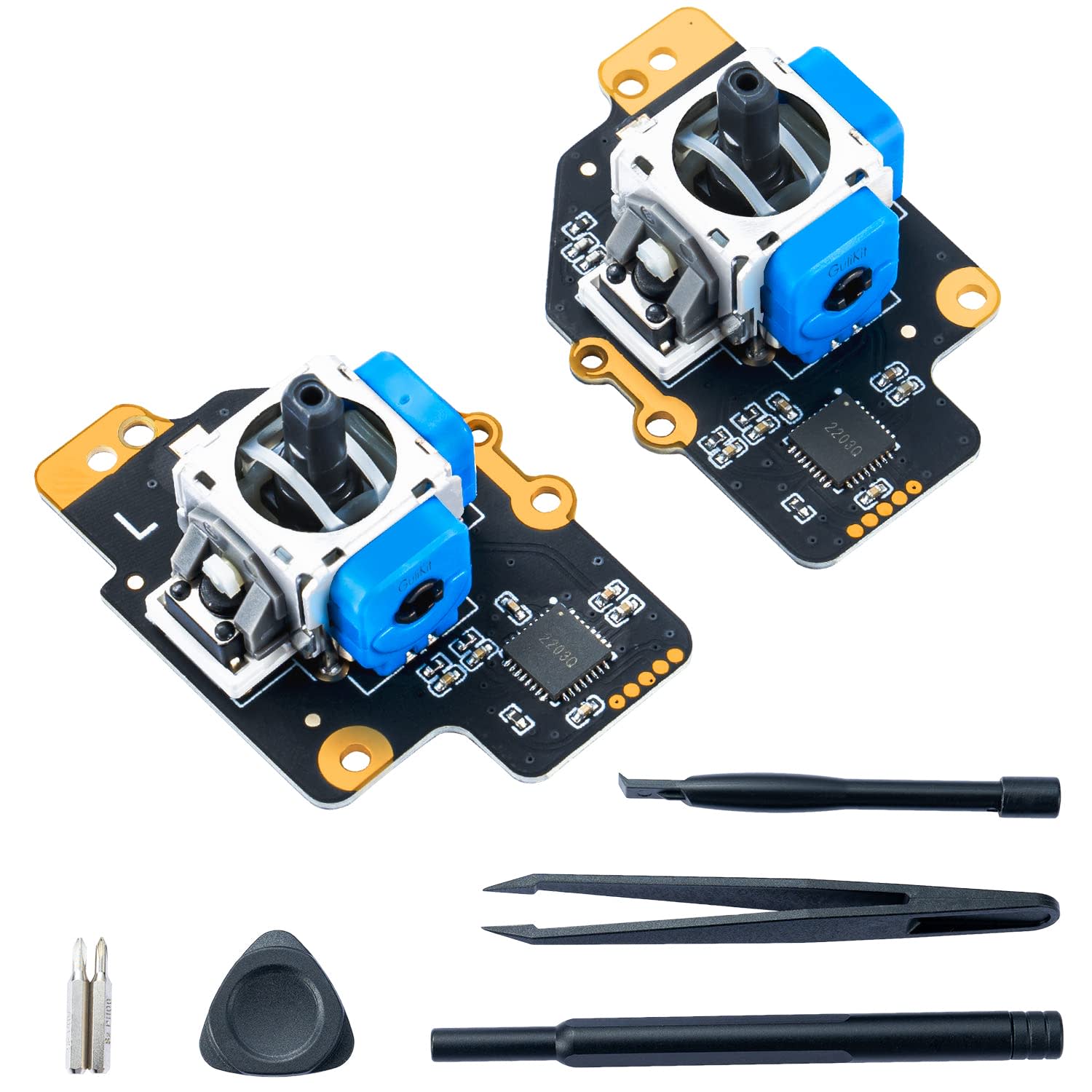
All three sense magnetic fields without touching anything, and that is where the similarity ends. Hall effect sensors generate a voltage across a current-carrying plate. AMR and TMR sensors change their electrical resistance instead — AMR by a few percent, TMR by more than a hundred.
That resistance figure is the number that explains the entire hierarchy. It determines signal strength, power draw, how small the magnet can be, and ultimately which technology ends up in a thumbstick versus a servo motor.
Note
Key Takeaways
- Hall effect produces a voltage from a bias current. Linear, cheap, mature, and the highest power draw of the three.
- AMR changes resistance by roughly 2–3% and reads angle over 180°, not 360°. Fast and stable, but ambiguous by nature.
- TMR changes resistance by 100–200%+ through a magnetic tunnel junction — the strongest signal by an order of magnitude.
- TMR elements are high-resistance, so they draw a fraction of the current a Hall sensor needs. That is why they land in wireless controllers.
- In motor control, Hall handles commutation, AMR and TMR handle angle. They solve different problems in the same machine.
- For gaming, both Hall and TMR eliminate stick drift. TMR's advantage is battery life and resolution, not longevity.
The Three Physical Effects, Briefly
These are genuinely different phenomena, not three grades of the same part.
The Hall effect was described in 1879. Run a current through a thin conductive plate, apply a magnetic field perpendicular to it, and the moving charge carriers get pushed sideways. That accumulation produces a small voltage across the plate, proportional to field strength. Modern Hall sensors are semiconductor plates with amplification on the same die, and the output is famously linear across a wide field range — which is the property that made them the default for position sensing for decades.
Anisotropic magnetoresistance (AMR) works differently. In a ferromagnetic film, electrical resistance depends on the angle between the current direction and the material's magnetisation. Rotate the field and the resistance changes. The effect is small — a swing of about 2–3% between the extremes — but it is fast, low-noise, and depends on field direction rather than field strength, which makes it insensitive to how far away the magnet sits.

Tunnel magnetoresistance (TMR) is the modern one. A magnetic tunnel junction stacks two ferromagnetic layers separated by an insulating barrier only a few atoms thick. Electrons tunnel through that barrier, and how easily they tunnel depends on whether the two layers' magnetisations are aligned. The resistance difference between aligned and opposed is enormous by comparison: commonly 100–200% and higher at room temperature in production sensors.
Info
There is a fourth member of this family, GMR (giant magnetoresistance), which sits between AMR and TMR at roughly 10–20%. It is the technology that made high-density hard drive read heads possible and won a Nobel Prize in 2007. TMR largely superseded it for new designs.
The Comparison That Matters
| Property | Hall Effect | AMR | TMR |
|---|---|---|---|
| Signal mechanism | Voltage from field | Resistance change | Resistance change |
| Typical output swing | mV per mT | ~2–3% | ~100–200%+ |
| Angular range | 360° (with pairs) | 180° (ambiguous) | 360° |
| Power draw | Highest | Low | Lowest |
| Sensitivity | Moderate | High | Highest |
| Magnet size needed | Larger | Small | Smallest |
| Temperature stability | Drifts, compensable | Good | Good, with hysteresis |
| Cost | Lowest | Low | Highest |
| Maturity | Very mature | Mature | Newer in consumer use |
Two rows carry most of the practical weight.
Output swing decides how much amplification you need and how much noise you can tolerate. A 2–3% AMR swing requires careful analogue design to read cleanly. A 150% TMR swing does not — the signal arrives large enough to digitise directly, which means fewer parts, less noise, and finer usable resolution.
Power draw is where TMR's tunnel junction becomes decisive. Junctions are high-resistance devices, often in the kilohm to megohm range, so reading one costs very little current. A Hall sensor has to push a bias current continuously through a low-resistance semiconductor plate just to produce an output at all. For a mains-powered industrial encoder nobody cares. For something running off a battery, it is the whole argument.
In Motor Control: They Do Different Jobs
The most common confusion here is treating these as competitors inside a motor. In a well-designed drive they usually coexist, because commutation and angle measurement are different requirements.
Hall sensors handle block commutation. A brushless DC motor running six-step commutation only needs to know which of six 60° sectors the rotor is in. Three Hall switches spaced around the stator answer that directly and cheaply, and their digital output feeds the driver with no conversion. This is why almost every low-cost BLDC motor has exactly three Hall sensors in it, and why they are usually switches rather than linear sensors.
AMR and TMR handle continuous angle. Field-oriented control needs to know the rotor's actual angle at all times, not which sector it occupies, because the whole point is to keep the stator field precisely orthogonal to the rotor field. That demands a smooth, high-resolution angular reading — which is what a magnetoresistive angle sensor with sine and cosine bridges provides.
Hall Switches — Commutation
Three digital sensors, 60° resolution, negligible cost. Sufficient for trapezoidal drive and for startup on sensorless systems that need an initial position.
AMR — Fast, Stable Angle
Excellent noise performance and very low latency, with one structural limit: the effect repeats every 180°, so a single AMR bridge cannot distinguish a rotor angle from its opposite. Fine for a 2-pole-pair machine mapped accordingly, awkward otherwise.
TMR — Full 360° Angle
Two bridges give unambiguous full-rotation angle with high resolution and very low power. The premium option, and increasingly the default for precision servo and robotics work.
Sensorless — No Sensor At All
Back-EMF estimation costs nothing in parts but fails at low speed and standstill. Common in fans and pumps, rare where holding torque matters.

The 180° ambiguity in AMR is the single most important practical fact about it. It is not a defect — it falls directly out of the physics, since resistance depends on the axis of magnetisation rather than its direction. Designs work around it by pairing AMR with a coarse Hall reference, or by matching the sensor to a motor whose pole count makes the ambiguity harmless. But you cannot ignore it.
In Game Controllers: Why TMR Arrived
The gaming application is a narrower problem than motor control, and the comparison collapses to two contenders.
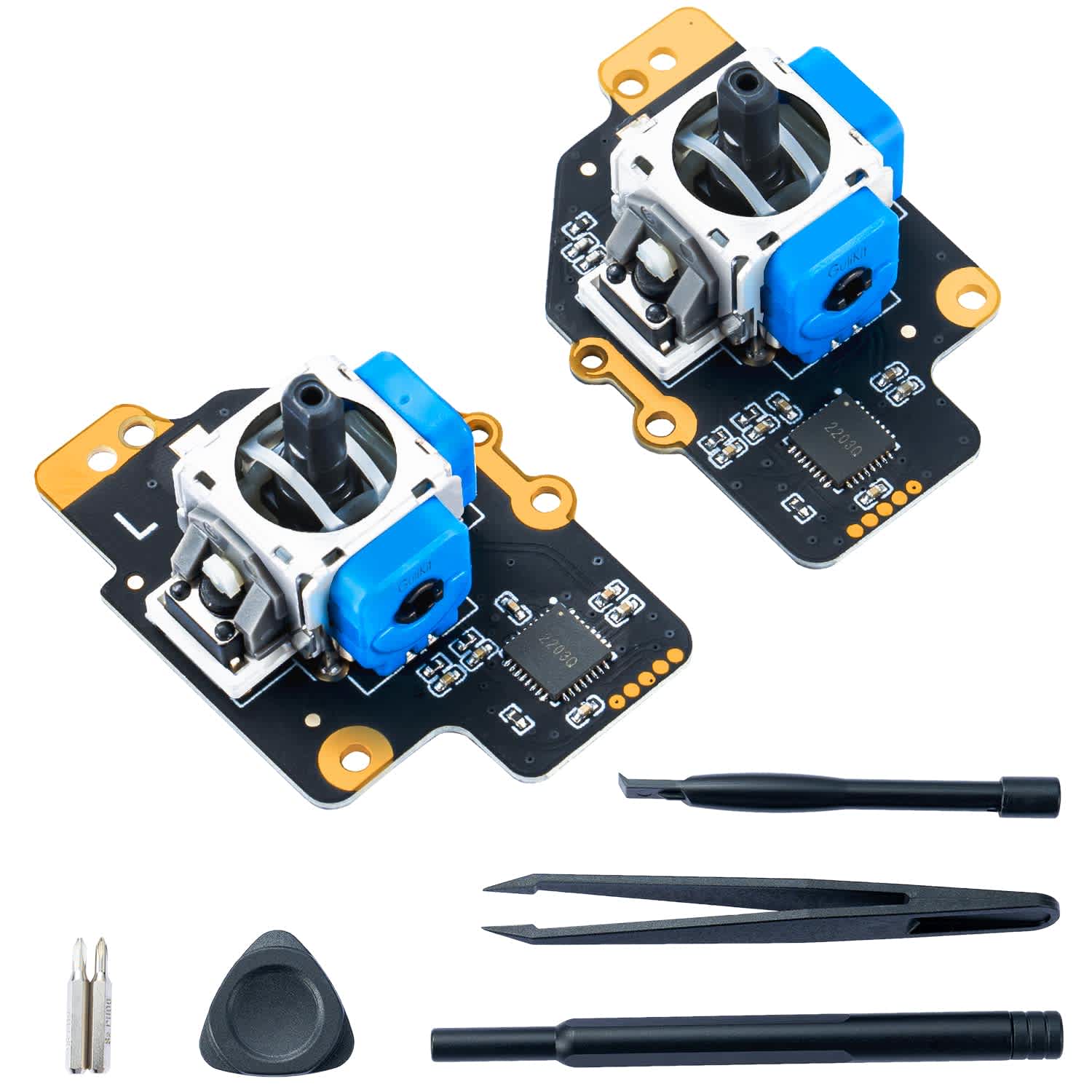
Conventional thumbsticks use potentiometers — physical wipers dragging across a resistive track. The track wears, the contact gets noisy, and the controller starts reporting movement that is not happening. That is stick drift, and it is a wear-out mechanism, not a manufacturing defect. We covered the symptom and the repair options in how to fix controller stick drift.
Both Hall effect and TMR modules solve it the same way: remove the physical contact entirely. A magnet sits on the stick gimbal, a sensor reads its field, and nothing rubs against anything. Neither is "more drift-proof" than the other, because both have already reduced the wear mechanism to the stick's own pivot bearings.
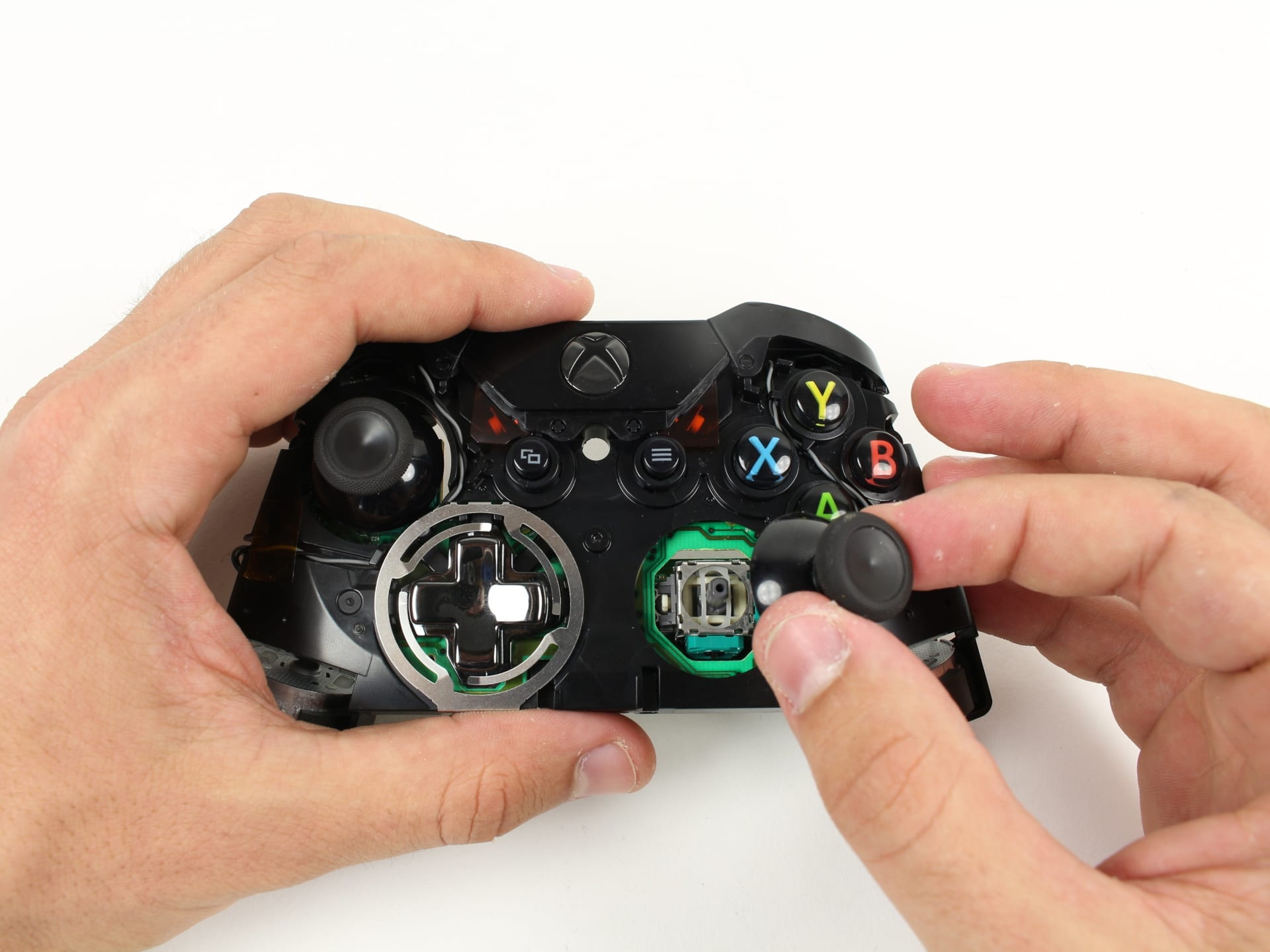
Where they differ is downstream of that:
Battery life. Two sensors reading continuously at high rate is a real load on a wireless controller. TMR's high-resistance junctions cut that consumption substantially, which matters in a device you want to last a full session.
Resolution and noise floor. A larger signal swing digitises more cleanly, which shows up as smoother output at small stick deflections — precisely the region that matters for aiming, and the region where deadzone settings are most fiddly. If you have ever fought with tiny stick inputs, our guides to controller deadzone settings and Steam Input response curves cover what to do about it.
Module size. TMR works with weaker fields, so it tolerates a smaller magnet and a shallower module — useful in handheld designs where vertical space is scarce.
For a full side-by-side of the two as a purchase decision, including when the upgrade is worth paying for, see TMR vs Hall effect joysticks.
Keyboards Use the Same Physics
Analogue keyboard switches run the identical playbook one layer down. A magnet in the stem, a sensor under the socket, and a continuous position reading instead of a binary contact — which is what makes adjustable actuation points and rapid trigger possible at all.
Hall effect dominates here because keyboards are usually wired, which removes TMR's power advantage from the argument entirely. When a keyboard does not need to worry about battery life, the cheaper mature technology wins on cost. The trade-offs against traditional switches are covered in magnetic vs mechanical switches, and the related optical approach — which uses light rather than magnetism for the same non-contact goal — in mechanical vs optical keyboards.
Warning
Analogue switches sense position, not just contact, which means firmware decides what counts as a keypress. That is a genuine capability, but it is also why some competitive titles have restricted specific rapid-trigger and null-bind behaviours. Check the rules before relying on a feature in ranked play.
What None of Them Fix
Worth stating plainly, because magnetic sensing gets treated as a cure-all.
Mechanical slop remains mechanical. A gimbal with loose tolerances feels loose regardless of what reads its position. Sensor technology changes how the position is measured, not how well the assembly is built.
Centring is a spring problem. If a stick does not return to centre reliably, that is the return spring and the gimbal, and a TMR sensor will report the off-centre position with excellent precision.
Calibration still exists. Magnet placement varies between units, so modules ship with calibration routines. A poorly calibrated TMR stick is worse than a well-calibrated Hall one.
Temperature affects all three. Hall sensitivity drifts with temperature and is compensated in the driver IC. Magnetoresistive sensors are more stable but carry hysteresis characteristics of their own. Every serious implementation compensates; none of them are immune.
Frequently Asked Questions
What is the difference between Hall effect, AMR and TMR sensors?
Hall effect sensors generate a voltage when a magnetic field crosses a current-carrying plate. AMR and TMR sensors change electrical resistance instead — AMR by about 2–3% based on field direction, TMR by 100–200% or more through a magnetic tunnel junction. TMR gives the strongest signal at the lowest power, and Hall is the cheapest and most mature.
Which sensor is best for motor control?
They serve different roles. Three Hall switches provide cheap 60° sector detection for six-step commutation. AMR and TMR angle sensors provide the continuous high-resolution rotor angle that field-oriented control requires. Precision servo and robotics work increasingly favours TMR for its 360° unambiguous output and low power draw.
Why can't AMR sensors measure a full 360 degrees?
Because anisotropic magnetoresistance depends on the axis of magnetisation rather than its direction, the resistance signal repeats every 180°. A single AMR bridge therefore cannot distinguish an angle from its opposite. Designs resolve this with a coarse Hall reference or by matching the sensor to a motor pole count where the ambiguity does not matter.
Are TMR joysticks better than Hall effect joysticks?
For drift, no — both remove the wearing contact that causes it, so neither is more durable. TMR's real advantages are lower power draw, which extends wireless battery life, a stronger signal that digitises more cleanly at small deflections, and a smaller module. Whether that justifies the price depends on whether you play wireless.
Do Hall effect or TMR sensors wear out?
The sensors themselves have no contacting parts and no established wear-out mechanism in normal use. What still wears is everything mechanical around them: the gimbal, the return springs, and the stick pivot. Magnets lose negligible strength over a consumer product's life.
Why do keyboards use Hall effect rather than TMR?
Most analogue keyboards are wired, which removes TMR's main advantage — low power consumption — from the decision entirely. With battery life irrelevant, the cheaper and more mature Hall effect technology delivers the same adjustable actuation and rapid trigger behaviour for less money.
The Bottom Line
The three technologies are not a quality ladder. They are three different answers to "how do I read a magnetic field," and each one dominates a distinct niche.
Hall effect wins on cost and maturity, which is why it is in almost every commutating motor and almost every analogue keyboard. AMR wins on speed and stability in angle sensing where 180° is enough. TMR wins on signal strength and power, which is exactly the combination a battery-powered precision device needs — hence its arrival in wireless controllers and high-end servo encoders at roughly the same time.
If you are buying a controller, the meaningful decision was already made when you left potentiometers behind. Everything after that is battery life and fine-motion resolution, not durability.
Component and interface photography courtesy of the respective manufacturers and publications, used for editorial coverage.
Sources
- TDK, TMR Angle Sensors: principles and advantages over Hall and AMR, retrieved 2026-08-01, https://product.tdk.com/en/techlibrary/productoverview/tmr-angle-sensors.html
- Allegro MicroSystems, Magnetic Sensor Technology Comparison: Hall Effect vs. Magnetoresistive, retrieved 2026-08-01, https://www.allegromicro.com/en/insights-and-innovations/technical-documents/hall-effect-sensor-ic-publications
- Infineon Technologies, Magnetic position sensors: Hall, AMR, GMR and TMR compared, retrieved 2026-08-01, https://www.infineon.com/cms/en/product/sensor/magnetic-sensors/
- Analog Devices, Understanding and Applying AMR Angle Sensors, retrieved 2026-08-01, https://www.analog.com/en/resources/technical-articles/amr-angle-sensors.html
- Texas Instruments, Brushless-DC Motor Commutation with Hall Effect Sensors, retrieved 2026-08-01, https://www.ti.com/lit/an/slaa503/slaa503.pdf