
Steam is the only major store that tells you whether a game used generative AI, and since January 2026 it tells you less than it used to. PlayStation, Xbox, Nintendo and the Epic Games Store carry no label at all. So the answer to "does this game use AI?" depends on where you shop, and on how carefully the developer filled in a form.
This guide covers where the disclosure lives, what Valve's rewritten rules leave out, what studios have admitted on the record, and a short check you can run before paying for anything.
Note
Key Takeaways
- Steam requires an "AI Generated Content Disclosure" on the store page. It sits under the game description, just above System Requirements.
- Since January 16, 2026, AI coding assistants and other behind-the-scenes efficiency tools no longer need disclosing. Only AI content that players see or hear does.
- About 10,258 Steam games, 8% of the catalogue, carried a disclosure in Totally Human Media's November 2025 count.
- PlayStation, Xbox, Nintendo and Epic have no comparable public disclosure policy.
- Most 2025–2026 controversies (Clair Obscur, Anno 117, The Alters, Crimson Desert) involved AI placeholders that shipped by mistake, not games built around AI.
- Voice actors' 2025 SAG-AFTRA agreement requires consent and a "reasonably specific description" before a studio uses a performer's digital replica.
Where Can You See If a Game Uses Generative AI?
On Steam, scroll past the "About This Game" text: a heading reading "AI Generated Content Disclosure" appears there if the developer declared any. Valve introduced the requirement on January 10, 2024, when it started letting AI-assisted games onto the store instead of rejecting them (The FPS Review, 2024).
Arc Raiders' page is a typical example. The block sits after the feature list and before System Requirements, and reads: "During the development process, we may use procedural- and AI-based tools to assist with content creation. In all such cases, the final product reflects the creativity and expression of our own development team."
Everywhere else, there's nothing to find. A February 2026 review by University of Melbourne researchers found no clear AI disclosure policy on the PlayStation, Xbox or Nintendo storefronts. itch.io has only an optional "AI Generated" tag, and neither the Epic Games Store nor GOG has a clear disclosure requirement (The Conversation, 2026).
Epic's position is deliberate. Tim Sweeney posted on November 26, 2025 that an AI tag "makes no sense for game stores, where AI will be involved in nearly all future production" (TweakTown, 2025).
| Storefront | Mandatory AI disclosure? | Where it appears |
|---|---|---|
| Steam | Yes | Store page, above requirements |
| itch.io | No, optional tag | Tag list |
| Epic Games Store | No | Not shown |
| GOG | No | Not shown |
| PlayStation Store | No public policy | Not shown |
| Xbox Store | No public policy | Not shown |
| Nintendo eShop | No public policy | Not shown |
Buying a multiplatform game on console? Check its Steam page first. The developer writes the disclosure about the game's content, and that content is usually the same on every platform.
What Steam's AI Disclosure Actually Covers After the 2026 Rewrite
Steam's form now asks only about AI content that ships in the game and reaches players, after Valve's January 16, 2026 rewrite exempted development tools such as code assistants. Valve's Steamworks documentation defines two categories (Steamworks, 2026).
Pre-Generated
"Any kind of content that ships with your game and is consumed by players that is created with the help of AI tools during development." That covers art, textures, audio, voice, writing and translation, plus the marketing material on the store page itself.
Live-Generated
"Any kind of content created with the help of AI tools while the game is running." Picture an NPC whose lines come from a language model at runtime (our look at how AI-driven NPCs work in current games goes into this). Developers have to describe the guardrails that stop it producing illegal content, and Valve bans live-generated adult sexual content outright. Since 2024, players have also been able to report illegal live-generated output through the Steam overlay (The FPS Review, 2024).
What Dropped Out in January 2026
The new form states that "efficiency gains through the use of these tools is not the focus of this section." Instead it is "concerned with the use of AI in creating content that ships with your game, and is consumed by players" (Generation Amiga, 2026).
In practice, a studio can use AI to write code, draft design documents or generate throwaway concept images without saying so, as long as none of it reaches the shipped game. That's a defensible line. It also means the label describes the product, not how it was made.
Info
Steam's label covers generative content, not every feature with "AI" in its name. DLSS, FSR and frame generation are machine-learning rendering features, and crowd systems like Unreal Engine's Mass AI, used in The Witcher 4 tech demo, are conventional game AI. Neither triggers the disclosure.
How to Check a Steam Page in Under a Minute
Checking a Steam page takes three steps: find the disclosure block, read its exact wording, then cross-check with a filter. Most disclosures run one or two sentences, and the wording tells you more than whether the label is there at all.
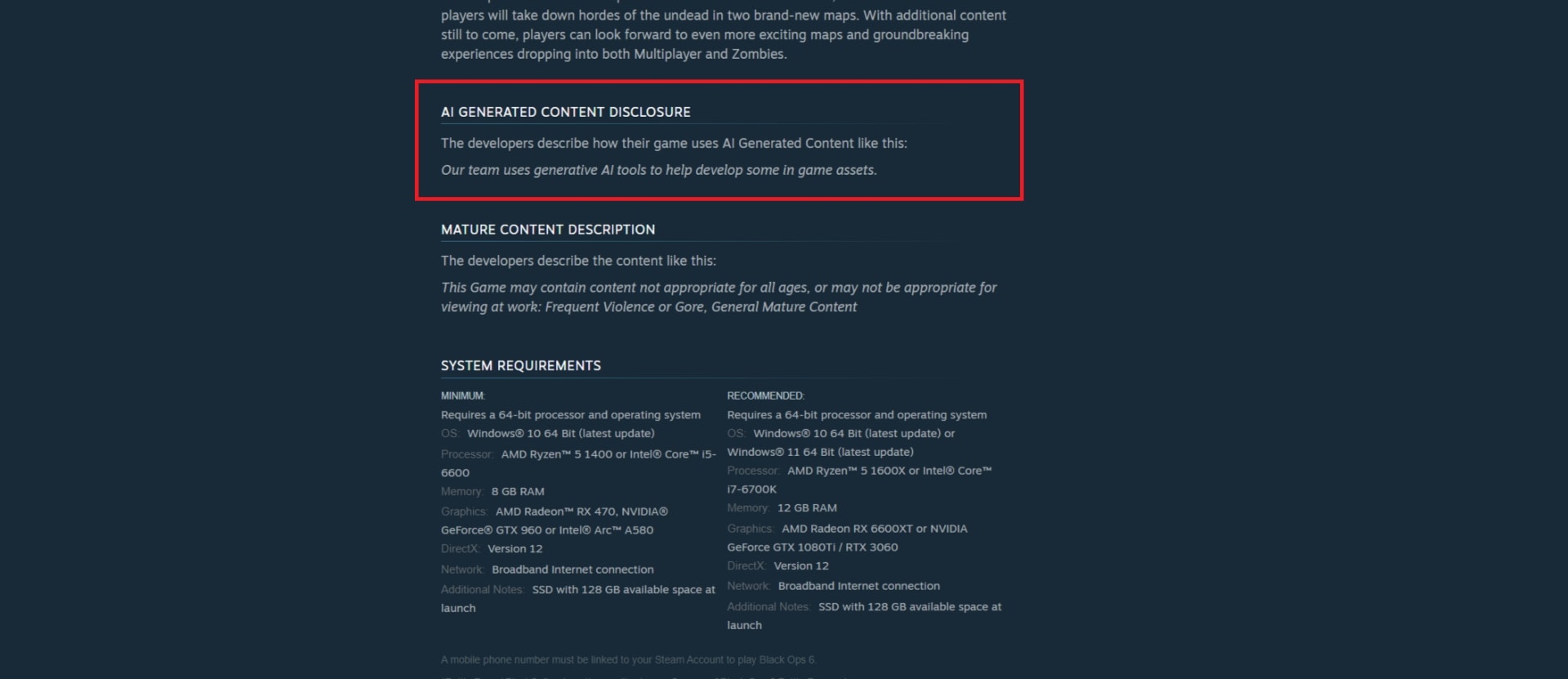
Find the block. Scroll to the end of the "About This Game" description. If the developer declared AI content, the "AI Generated Content Disclosure" heading sits there, above "Mature Content Description" and "System Requirements".
Read the verbs. "We may use procedural- and AI-based tools to assist" (Arc Raiders) describes a process. "Generative AI technology is used in a supplementary capacity during the creation of some 2D prop assets" (Crimson Desert, added after launch) names an asset type. A specific disclosure is one you can hold a studio to.
Filter whole lists. SteamDB added a filter in February 2025: open "Filter by user tags" on any SteamDB list and include or exclude "AI Content Disclosed" (GamingOnLinux, 2025). It only reflects what developers declared, so every gap in the self-reporting carries over.
Steam itself still has no store filter for AI disclosures.
What Studios Have Publicly Said They Use AI For
Studios that have gone on the record describe generative AI for textures, placeholders, QA automation and voice, while developers themselves have grown steadily more sceptical of it. The GDC 2026 State of the Game Industry survey of more than 2,300 professionals found 52% think generative AI is harming the industry, up from 30% a year earlier and 18% the year before (GDC, 2026).
Only 7% called its impact positive. 36% said they personally use it, and the most common uses were research and brainstorming (81%), code assistance (47%) and prototyping (35%). Artists were the most negative group, at 64%.
The on-record uses are fairly narrow:
- EA partnered with Stability AI in October 2025 to build tools for physically based rendering (PBR) textures and for pre-visualising 3D environments from prompts. EA's VP of creative innovation, Kallol Mitra, said AI "can draft, generate, and analyze, but it can't imagine, empathize, or dream" (EA, 2025).
- Square Enix set a target of automating 70% of QA and debugging tasks with generative AI by the end of 2027, in joint research with the University of Tokyo's Matsuo laboratory (Game Developer, 2025).
- Larian went the other way. After criticism of its plans for Divinity, Swen Vincke said in January 2026 that "there is not going to be any GenAI art in Divinity," and that the studio would stop using it for concept art exploration as well (Notebookcheck, 2026).
Games that disclose AI also sell. Working from review counts, Totally Human Media estimated that Steam games with AI disclosures had grossed about $660 million combined. Among those that earned over $1 million, the most common disclosed uses were in-game art (49%), voiceover or dialogue (27%), pre-production and concept work (13%), marketing (11%) and translation (9%) (Totally Human Media, 2025).
AI you switch on yourself is a separate question. RTX Remix's AI texture upscaling for mods, or Discord's Krisp noise suppression, is your choice, not the studio's.
The 2025–2026 AI Controversies and How Studios Responded
Most 2025–2026 controversies follow one pattern: AI placeholder art made early in development survived into the release build, and players found it before the studio said anything.
| Game | What players found | Studio response |
|---|---|---|
| The Alters (11 bit) | AI prompt text on an in-game monitor; AI translations | Apologised; "we should have simply let you know"; professional translations underway |
| Anno 117: Pax Romana (Ubisoft) | AI-generated loading-screen image | Called it "an unintended placeholder"; replaced in update 1.3 |
| Clair Obscur: Expedition 33 | AI placeholder textures, patched after launch | Indie Game Awards rescinded two wins in December 2025 |
| Arc Raiders | Text-to-speech voices built from licensed actor recordings | Re-recorded some lines with human actors |
| Crimson Desert (Pearl Abyss) | AI-generated 2D props, undisclosed at launch | Apologised, added a Steam disclosure, began a full asset audit |
The Alters set the template. In June 2025, 11 bit Studios admitted that an AI-generated placeholder had shipped and that it had used AI tools for "additional last minute translations." Its apology: "no matter what we decided, we should have simply let you know" (Game Developer, 2025).
Anno 117 showed that disclosing doesn't end the argument. Its Steam page carried a disclosure, and players still objected to an AI loading-screen image that Ubisoft called "an unintended placeholder that went unexamined in our review" (WN Hub, 2025).
Clair Obscur: Expedition 33 had the most public consequence. Sandfall said the textures were temporary placeholders that had since been patched out, but the Indie Game Awards still withdrew its Game of the Year and Debut Game awards, which went to Blue Prince and Sorry We're Closed instead. The organisers' reasoning: "While the assets in question were patched out and it is a wonderful game, it does go against the regulations we have in place" (Engadget, 2025).
Arc Raiders is the voice case. Its developer, Embark Studios, paid actors to license their voices for text-to-speech on lower-priority lines such as location pings. After criticism, CEO Patrick Söderlund said in March 2026 that some of those lines had been re-recorded: "A real professional actor is better than AI; that's just how it is" (Kotaku, 2026).

Crimson Desert repeated the placeholder pattern after its March 2026 launch. Pearl Abyss said 2D props made with "experimental AI generative tools" were left in unintentionally and promised to replace them (Engadget, 2026). Crystal Dynamics made a similar claim about Tomb Raider: Legacy of Atlantis, saying its AI placeholders were all "replaced or refined by humans". We covered that in our Legacy of Atlantis release and AI disclosure breakdown.
What Voice Actors Won in the 2025 SAG-AFTRA Deal
SAG-AFTRA's 2025 Interactive Media Agreement requires explicit consent before a studio uses a performer's AI digital replica, and it ended a strike that began in July 2024. Members ratified it on July 9, 2025, with 95% voting in favour (Frankfurt Kurnit Klein & Selz, 2025).

The main AI terms, per a January 2026 legal analysis (Frankfurt Kurnit Klein & Selz, 2026):
- Consent must be "clear and conspicuous", in a separate document or a specifically signed rider, with a "reasonably specific description" of the use. That includes whether the replica generates lines in real time and whether it covers sensitive material such as profanity or slurs.
- Usage reports are due within 90 days of a game's release, listing which characters used digital replicas and how pay was calculated.
- Pay per generated line applies to vocal replicas, with roughly ten words counting as one line.
- Strike suspension lets performers withdraw consent for new replica-generated material during a strike.
The agreement runs to October 31, 2028 and binds signatory companies, not every studio. For players, it means union-covered replica voices in big-budget games should come with consent and paperwork. None of that paperwork shows up on a store page.
Why a Missing Label Doesn't Prove a Game Is AI-Free
A game without a Steam disclosure may simply not have declared its AI use, because the system relies entirely on developers reporting themselves. Crimson Desert added its disclosure only after launch, and The Alters shipped without disclosing its AI translations. Valve doesn't publish figures on how many games under-report, so nobody outside the company knows how big that gap is.
The 2026 exemption widens the gap by design. The uses GDC respondents reported most often, research, brainstorming, code and prototyping, are development tasks that never need a label.
A label isn't a quality verdict either. Anno 117 disclosed and still drew criticism, while a game with no label may have declared nothing it should have. Read it as one piece of evidence about one game.
AI that changes what you see on screen, like upscaling, is covered in our AI upscaling news roundup and our comparison of DLSS 4 and FSR 4 on budget GPUs.
A Five-Point Pre-Purchase Check
Beyond the one-minute Steam page check, a fuller pre-purchase check takes a few minutes and uses five things you can see yourself. They are the disclosure text, how specific it is, launch-week reports, recent player reviews and the studio's own statement.
- Open the Steam page, even for a console purchase, and read the AI Generated Content Disclosure word for word.
- Note the specifics. "Some 2D prop assets" or "text-to-speech for pings" tells you far more than "AI-based tools may assist."
- Search the game's name plus "AI" in the week after launch. Crimson Desert's AI props were being reported by players the day after release.
- Read the most recent Steam reviews for mentions of AI art, voices or translation.
- Look for a studio statement. A specific, checkable claim like Crystal Dynamics' "replaced or refined by humans" can be tested at launch. A vague one can't.
Frequently Asked Questions
How do I know if a game uses generative AI?
On Steam, scroll to the end of the game's description and look for the "AI Generated Content Disclosure" heading, just above System Requirements. PlayStation, Xbox, Nintendo and Epic show no label, so check the same game's Steam page or the studio's own statements.
Does Steam require developers to disclose AI use?
Yes, for AI content that ships in the game or appears on its store page, whether it was generated during development or live while you play. Since January 16, 2026, AI tools used only for efficiency, such as code assistants, no longer need disclosing.
How many Steam games use AI?
Totally Human Media counted 10,258 Steam games with an AI disclosure in November 2025, about 8% of the catalogue. That counts declarations, not actual use, so any undeclared AI is missing from it.
Do PlayStation and Xbox label AI-generated games?
PlayStation, Xbox and Nintendo storefronts had no clear public AI disclosure policy as of a February 2026 University of Melbourne review. Epic's CEO has argued against AI labels altogether.
Can a game studio use a voice actor's voice with AI?
Under SAG-AFTRA's 2025 agreement, signatory studios need the performer's clear written consent and must describe how the digital replica will be used. They also owe per-line pay for generated dialogue and must report usage within 90 days of release. Studios that haven't signed aren't bound by those terms.
The Bottom Line
The Steam disclosure is the only standardised AI label in games, so scroll to it before you buy; it takes under a minute. It's also self-reported, limited to what ships, and missing from every console store.
The most useful habit is reading the disclosure's exact wording and giving a new release a few days. In four of the five cases in the table, players found the AI content before the studio explained it.
Images courtesy of Notebookcheck, Valve via Windows Central, SAG-AFTRA via Future plc, Pearl Abyss via Notebookcheck and Embark Studios, used for editorial coverage.
Sources
- Valve, Content Survey (Steamworks Documentation), retrieved 2026-09-10, https://partner.steamgames.com/doc/gettingstarted/contentsurvey
- Valve, ARC Raiders on Steam (store page, AI Generated Content Disclosure section), retrieved 2026-09-10, https://store.steampowered.com/app/1808500/ARC_Raiders/
- Generation Amiga, Valve rewrites Steam's AI disclosure rules for developers, retrieved 2026-09-10, https://www.generationamiga.com/2026/01/17/valve-rewrites-steams-ai-disclosure-rules-for-developers/
- The FPS Review, Valve Ushers in AI Content on Steam with New Developer Guidelines, retrieved 2026-09-10, https://www.thefpsreview.com/2024/01/10/valve-ushers-in-ai-content-on-steam-with-new-developer-guidelines-introduces-new-system-that-allows-users-to-report-on-illegal-ai-content/
- GDC, GDC 2026 State of the Game Industry Reveals Impact of Layoffs, Generative AI, and More, retrieved 2026-09-10, https://gdconf.com/article/gdc-2026-state-of-the-game-industry-reveals-impact-of-layoffs-generative-ai-and-more/
- Totally Human Media, Games With AI Disclosures Have Grossed an Estimated $660M on Steam, retrieved 2026-09-10, https://www.totallyhuman.io/blog/games-with-ai-disclosures-have-grossed-an-estimated-660m-on-steam
- The Conversation, Are video game developers using AI? Players want to know, but the rules are patchy, retrieved 2026-09-10, https://theconversation.com/are-video-game-developers-using-ai-players-want-to-know-but-the-rules-are-patchy-274850
- TweakTown, Epic Games boss Tim Sweeney doesn't like how Steam puts labels on games made with AI, retrieved 2026-09-10, https://www.tweaktown.com/news/109084/epic-games-boss-tim-sweeney-doesnt-like-how-steam-puts-labels-on-games-made-with-ai/index.html
- GamingOnLinux, SteamDB now lets you filter out Steam games with AI Generation, retrieved 2026-09-10, https://www.gamingonlinux.com/2025/02/steamdb-now-lets-you-filter-out-steam-games-with-ai-generation/
- Electronic Arts, EA and Stability AI partner to empower artists, designers, and developers (EA newsroom), retrieved 2026-09-10, https://www.ea.com/news/ea-partners-with-stability-ai
- Game Developer, Square Enix wants to use gen AI to automate 70 percent of QA and debugging by late 2027, retrieved 2026-09-10, https://www.gamedeveloper.com/business/square-enix-wants-to-use-gen-ai-to-automate-70-percent-of-qa-and-debugging-by-late-2027
- Notebookcheck, Larian Studios walks back generative AI use in Divinity after fan backlash, retrieved 2026-09-10, https://www.notebookcheck.net/Larian-Studios-walks-back-generative-AI-use-in-Divinity-after-fan-backlash-clarifies-future-AI-role.1201780.0.html
- Game Developer, The Alters developer apologizes for not disclosing use of generative AI, retrieved 2026-09-10, https://www.gamedeveloper.com/business/11-bit-apologizes-for-not-disclosing-gen-ai-use-in-the-alters
- WN Hub, Ubisoft acknowledges that an AI-generated image "slipped through our review process" in Anno 117: Pax Romana, retrieved 2026-09-10, https://wnhub.io/news/Generative_AI/item-49309
- Engadget, The Indie Game Awards snatches back two trophies from Clair Obscur over its use of generative AI, retrieved 2026-09-10, https://www.engadget.com/gaming/the-indie-game-awards-snatches-back-two-trophies-from-clair-obscur-over-its-use-of-generative-ai-164730842.html
- Kotaku, Arc Raiders Replacing AI-Generated Voices With Human Actors, retrieved 2026-09-10, https://kotaku.com/arc-raiders-replaced-ai-generated-content-human-recorded-dialogue-voices-2000678774
- Engadget, Crimson Desert developer apologizes and promises to replace AI-generated art, retrieved 2026-09-10, https://www.engadget.com/gaming/crimson-desert-developer-apologizes-and-promises-to-replace-ai-generated-art-183716439.html
- Game Informer, Tomb Raider: Legacy Of Atlantis Used AI At One Point, But Devs Say All AI Assets Have Been 'Replaced Or Refined By Humans', retrieved 2026-09-10, https://gameinformer.com/opinion/2026/06/03/tomb-raider-legacy-of-atlantis-used-ai-at-one-point-but-devs-say-all-ai-assets
- Frankfurt Kurnit Klein & Selz, New SAG-AFTRA 2025 Interactive Media Agreement Approved by Members, retrieved 2026-09-10, https://ipandmedialaw.fkks.com/post/102ksuq/new-sag-aftra-2025-interactive-media-agreement-approved-by-members
- Frankfurt Kurnit Klein & Selz, Inside the New SAG-AFTRA Interactive Media Agreement: New Standards for AI and Digital Replicas, retrieved 2026-09-10, https://technologylaw.fkks.com/post/102mewu/inside-the-new-sag-aftra-interactive-media-agreement-new-standards-for-ai-and-di